A bearing in a packaging line starts running 1.2 degrees hotter than usual on a Tuesday morning. Nobody notices. By Thursday, the vibration pattern shifts. By the following Monday, the line is down for eleven hours. The repair costs $4,000. The lost production costs $87,000.
That scenario plays out constantly across manufacturing, logistics, and asset-heavy service industries. According to Siemens’ 2024 True Cost of Downtime report, the world’s 500 largest companies lose roughly $1.4 trillion per year to unplanned outages, about 11% of their total revenue. In automotive manufacturing, an idle production line burns through $2.3 million per hour.
What does AIoT mean?
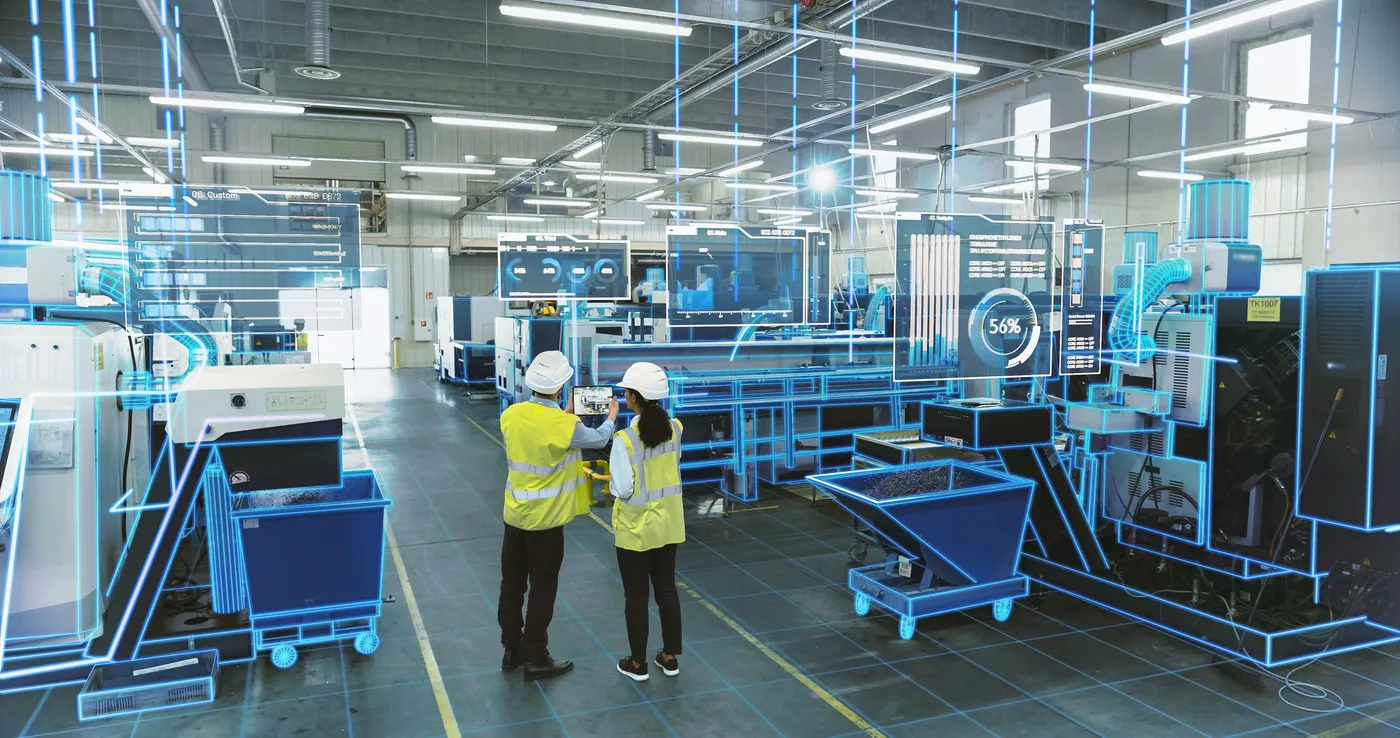
The fix for this particular class of problem has a name: AIoT, or the Artificial Intelligence of Things. The meaning of AIoT is straightforward: it is the integration of artificial intelligence (specifically machine learning, computer vision, and increasingly large language models) with networks of connected sensors and devices. IoT collects the data. AI makes sense of it. Together, they turn raw sensor readings into decisions, often faster than any human operator could.
Where standard IoT gives you visibility (dashboards, alerts, historical trends), AIoT adds the ability to interpret and act. A temperature sensor on its own tells you the current reading. An AIoT system tells you that the reading, combined with a subtle shift in vibration frequency and a slight increase in current draw, means the motor will fail within 72 hours.
The concept is not new. Connected sensors have existed for decades, and applying algorithms to sensor data is older than the term “IoT” itself. What changed is the economics. Sensor costs have dropped by orders of magnitude. Cloud compute is cheap. Edge processors capable of running inference models now cost less than $10 per unit. And the AI models themselves have gotten dramatically better at working with noisy, real-world data from industrial environments.
The result is that AIoT has moved from pilot projects and proof-of-concept demos into production deployments with measurable returns. MarketsandMarkets projects the AIoT market to grow from roughly USD 25 billion in 2025 to over USD 80 billion by 2030. Manufacturing accounts for the largest share of that spending, but healthcare, logistics, energy, and smart building management are all accelerating.
What does AIoT look like in practice?
Take predictive maintenance, the most mature and well-understood AIoT application. Sensors on a piece of equipment measure vibration, temperature, current draw, acoustic emissions, and other signals at high frequency. An AI model trained on historical failure data learns the signatures that precede breakdowns, sometimes weeks or months before anything goes wrong. When those signatures appear, the system flags the issue, and in more advanced deployments, it can automatically adjust machine parameters to delay or prevent the failure entirely.
Siemens has deployed this at scale through its Industrial Edge platform. Armv9-based AI sensors on production lines monitor motors, conveyors, and actuators in real time. When a bearing starts running hot, the system can autonomously slow the motor, rebalance loads, or trigger a cooling cycle without waiting for a human to intervene. The models learn continuously, getting better with each cycle. Manufacturers using these approaches report reduced maintenance costs of up to 30% and measurable improvements in overall equipment effectiveness.
Honeywell’s collaboration with Google Cloud takes a different angle: autonomous plant agents that connect maintenance intelligence to supply chain systems. If a compressor shows early signs of degradation, the system doesn’t just alert a technician. It checks parts inventory, schedules the repair during planned downtime, and adjusts production scheduling to account for the capacity reduction. The maintenance decision feeds directly into operational planning.
Beyond predictive maintenance
But predictive maintenance is only one slice of AIoT. The pattern of “sensors collect, AI decides, systems act” applies across a wide range of business operations.
In commercial laundry and textile services, RFID-tagged linen tracked through tunnel washers and folding lines generates enormous volumes of data. AIoT systems can detect processing anomalies (a washer that’s running slightly out of spec, a dryer that’s taking longer than normal) and correlate them with quality outcomes downstream. The value isn’t just in preventing equipment failure. It’s in connecting equipment behaviour to business outcomes like linen life, customer returns, and cost per wash.
In logistics and fleet management, GPS and telematics sensors on vehicles produce continuous streams of location, speed, fuel consumption, and engine diagnostic data. AI models built on top of this data can optimise routing in real time, predict vehicle maintenance needs, flag driver behaviour that increases accident risk, and forecast fuel costs with far greater accuracy than historical averages. The competitive advantage compounds over time as the models learn from more data.
In building management, sensors measuring occupancy, temperature, humidity, CO2 levels, and energy draw feed AI systems that dynamically adjust HVAC, lighting, and access control. The result isn’t just energy savings (though those can be substantial). It’s the ability to understand how spaces are actually used and make capital allocation decisions based on real data rather than assumptions.
Practical realities for business operators
For business operators considering AIoT, there are a few practical realities worth understanding.
First, the value of AIoT is almost entirely dependent on the quality and structure of the data feeding it. A sensor that reports every ten minutes is fundamentally less useful than one reporting every second, depending on what you’re trying to detect. Poorly calibrated sensors, inconsistent data formats, gaps in coverage: these are the problems that kill AIoT projects, not the AI itself. Any serious AIoT initiative starts with an honest assessment of your existing sensor infrastructure and data pipeline.
Second, edge computing is where the momentum is heading. The 2025-2026 period is seeing rapid convergence of edge AI processing with 5G and low-power wide-area networking. Processing data at or near the source (rather than sending everything to the cloud for analysis) reduces latency, lowers bandwidth costs, and enables real-time responses that cloud-only architectures simply cannot match. For applications where milliseconds matter, like a safety shutdown on a production line, edge processing is not optional.
Third, AIoT does not require a massive upfront investment to get started. The most successful deployments tend to begin with a specific, well-defined problem (like unplanned downtime on a critical piece of equipment) rather than a grand “digitise everything” strategy. Instrument one process, prove the return, then expand. Modular sensor platforms and pay-as-you-go cloud analytics have made this incremental approach viable even for mid-market operators.
Fourth, the human element matters more than vendors like to admit. An AIoT system that generates alerts nobody trusts or acts on is worse than useless, because it creates a false sense of coverage. Successful deployments invest as much in change management, operator training, and workflow integration as they do in the technology itself. The system needs to fit into the way people actually work, not the other way around.
The AIoT market is growing fast, and the technology is genuinely capable of delivering returns that would have been impossible five years ago. But the businesses getting the most from it are not the ones buying the most sensors. They are the ones asking the right questions about what they need to detect, how fast they need to act, and what decision should follow. The AI is the easy part. Knowing what to do with it is where the actual competitive advantage lives.
 Isaac Hayes •