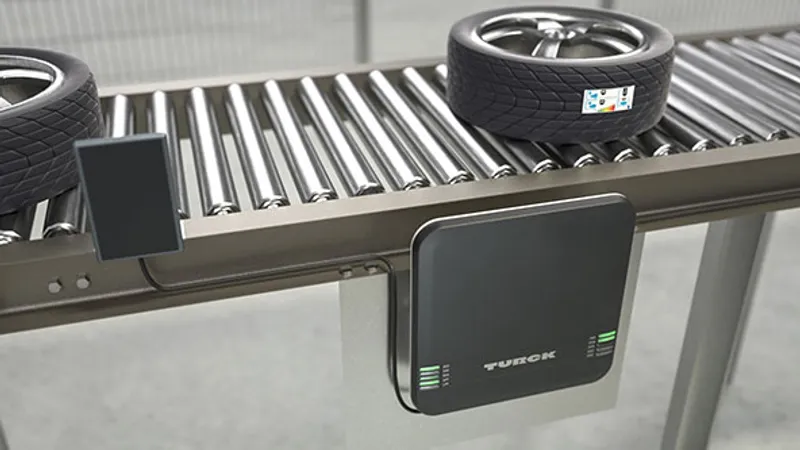
UHF RFID changes warehouse inventory and retail tracking. Count 50,000 items in minutes with no line of sight needed. Learn how tags, readers, and antennas work together.
UHF RFID Explained: What It Is and How It Actually Works
Say you run a warehouse. Fifty thousand items on the shelves, and your customer wants a stock count by end of day. With barcodes, that means someone physically walking every aisle, pointing a scanner at every individual item, one at a time. You’re talking about a full day for one person, and the count’s probably already drifted by the time they finish.
Now imagine you could count that entire warehouse in minutes, completely autonomously.
That’s UHF RFID. This post covers the fundamentals: what it is, how it works, and the three core components you need to understand before deploying it.
A Bit of Background
I’ve spent the better part of a decade building and deploying RFID systems in commercial and industrial environments, from laundry operations tracking tens of thousands of garments through wash cycles, to warehouse portals reading pallets at dock doors. I hold patents in the space and have seen enough deployments go well and go badly to know what actually matters versus what just looks impressive on a datasheet.
What Is RFID?
RFID stands for Radio Frequency Identification. It’s a broad term. It just means using radio waves to identify physical objects. There are three frequency bands in common use, and you’ve almost certainly interacted with all of them without realising it.
Low Frequency (LF) is the technology behind your pet’s microchip and the immobiliser in your car key. Very short range, a couple of centimetres, but it works well near water and tissue, which is exactly why it ends up inside your dog.
High Frequency (HF) covers NFC: your tap-and-go card, your Myki or Opal card, the chip symbol on your passport. About thirty centimetres of range, designed for deliberate close-range interactions where you’re intentionally presenting the tag.
Ultra High Frequency (UHF) is a different beast entirely. One to twelve-plus metres of range. Hundreds of tags per second. No line of sight required. This is what runs warehouse inventory systems, retail stock tracking at Zara and Uniqlo, toll road tags, airport baggage handling, and commercial laundry operations. UHF is what we’re focused on here.
The Three Core Components
Every UHF RFID system comes down to three things: tags, readers, and antennas. The tag is the thing you’re identifying. The reader is the brain doing the communicating. The antenna shapes the radio energy and defines where in physical space the system can actually see.
Tags
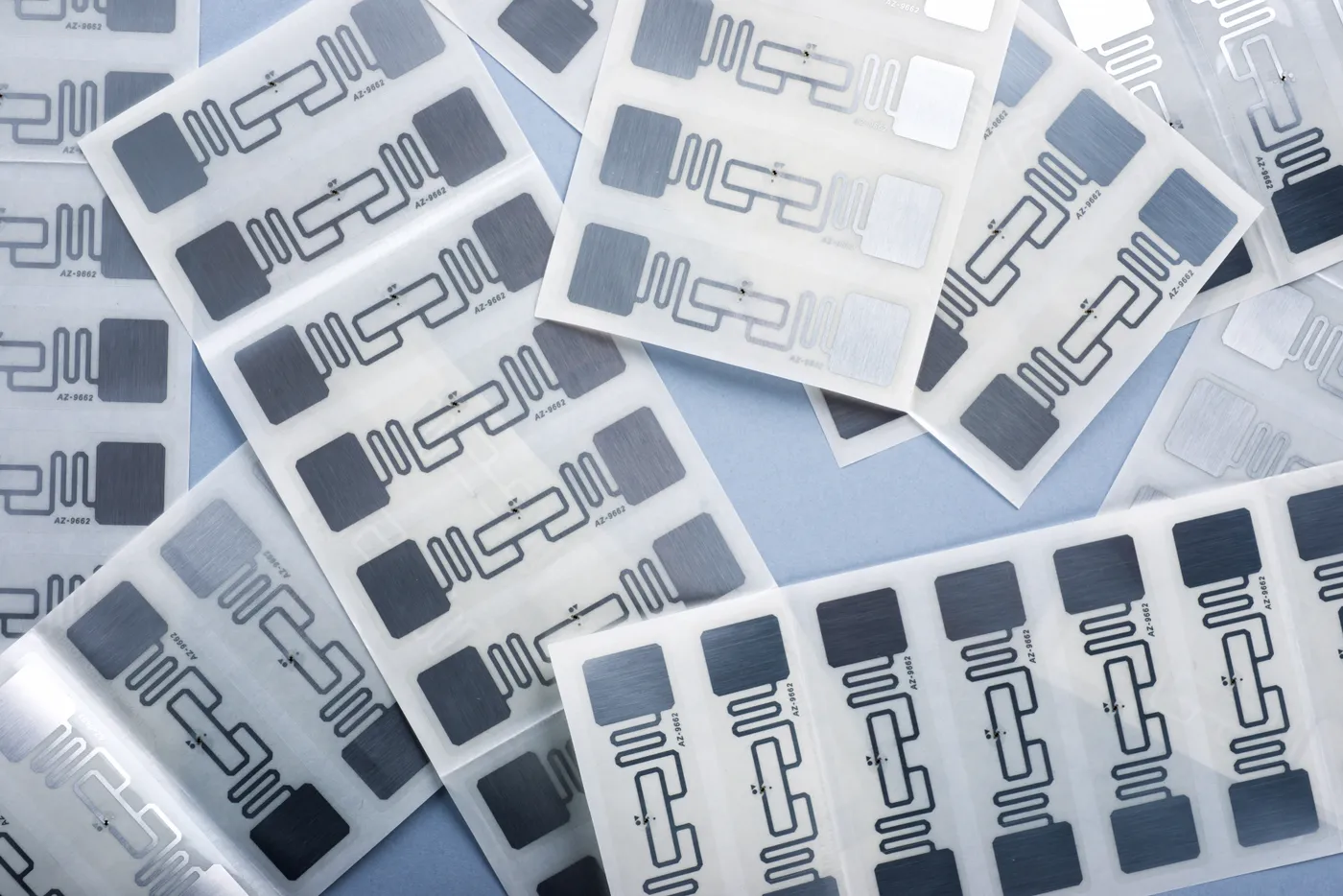
A UHF RFID tag is two things: a tiny microchip and an antenna. That’s it. No battery, no internal power source. It sits there doing absolutely nothing until a reader wakes it up. These are called passive tags, and they account for the vast majority of UHF deployments.
So how does something with no battery talk back?
The reader emits radio waves through its antenna, flooding an area with RF energy. When a passive tag enters that field, the tag’s antenna harvests enough of that energy to power the chip. The chip then modulates the signal and reflects it back. This is called backscatter.
The best analogy I’ve found: imagine shining a torch at someone holding a mirror. They tilt the mirror up and down, reflecting light back at you in a pattern, like morse code. The mirror isn’t generating its own light. It’s just reflecting what you sent in a meaningful way. The reader is the torch. The tag is the mirror.
What the tag sends back is, at minimum, a unique identifier. Think of it like a licence plate: it doesn’t tell you the colour of the car or who’s driving, it’s just a number you look up in a database.
That identifier is called the EPC, Electronic Product Code. Typically 96 bits, which gives you more unique combinations than you’d ever realistically need. But the chip has more than one memory bank. There’s also the TID, a factory-written serial number baked into silicon that can’t be changed, useful when you need to guarantee authenticity. And on some chips there’s a small User Memory bank where you can write custom data. Not much (we’re talking bytes, not megabytes), but enough for a batch number or date code so you don’t need a database round-trip for basic lookups.
Tags come in a wide range of form factors. A simple adhesive label, called a wet inlay, is a paper or plastic sticker with the chip and antenna embedded. A few cents each in volume. That’s what retailers stick on clothing labels. But if you need a tag to survive an industrial wash at 80°C, mount on a metal asset, or get embedded in concrete, you’re into ruggedised hard tags with plastic or ceramic housings. Those run anywhere from a dollar to fifteen dollars each depending on what you need them to do.
One thing worth flagging now: UHF radio waves and metal don’t get along. Metal reflects the signal. Water absorbs it. Stick a standard label tag flat on a steel shelf and it’ll barely read, if it reads at all. That’s why specialised on-metal tags exist with a built-in spacer layer. Tag selection is one of the most important decisions in any RFID project, and getting it wrong is probably the most common and expensive mistake I see.
Readers
If the tag is the mirror, the reader is both the torch and the eyes. It generates the RF energy that powers tags and decodes what comes back.
A reader is essentially a specialised radio, transmitter and receiver in one box. It follows the EPC Gen2 protocol, the global standard for how readers and tags communicate. The key benefit of that standard is interoperability, marketed under the brand name RAIN RFID. RAIN is to UHF RFID what WiFi is to wireless networking. If the tag, reader, and antenna all carry the RAIN mark, they work together regardless of manufacturer.
Readers come in two main form factors. Fixed readers are permanently mounted. Think a reader bolted above a dock door with antennas on either side, scanning every pallet that passes through. Handheld readers look like chunky barcode scanners with a built-in antenna, letting a warehouse worker sweep the shelves and read thousands of tags in minutes instead of scanning barcodes one at a time.
Here’s where the reader really earns its keep: when you’ve got two hundred tagged boxes on a pallet and they all try to respond at once, signals overlap and garble. That’s called collision. The Gen2 protocol handles this through an anti-collision algorithm that tells tags to take turns in a rapid, randomised sequence. That’s how you get read rates of hundreds of tags per second. The reader is having an individual conversation with each tag, it just does it fast enough that from the outside it looks simultaneous.
Antennas
The antenna shapes and directs RF energy from the reader into physical space. It defines your read zone, where in three dimensions tags will actually be detected. Get the antenna wrong and you’ll either miss tags you need or pick up tags you don’t want. Both are problems.
Two concepts matter here.
Polarisation. Antennas are either linearly or circularly polarised. A linear antenna focuses energy in a single plane. You get more range, but the tag antenna needs to be roughly aligned with it. Turn the tag 90 degrees and you can lose it entirely. A circularly polarised antenna spreads energy in a rotating pattern, so tag orientation matters much less, but you give up some range for that flexibility. In most real-world applications where you can’t control how items are positioned, like a bin of tagged garments, circular is the safer choice.
Beam pattern. This is how wide or narrow the antenna’s field is. A narrow beam gives you a focused, predictable read zone. Good for portals where you need to know exactly what passed through. A wide beam covers more area but makes it harder to control exactly what gets read. You end up picking up tags from the next aisle over if you’re not careful.
Antenna selection and placement is where a lot of deployment problems either get solved or created. More on that in a future post.
Putting It Together
Tags are passive devices that wake up when a reader illuminates them and reflect back their identity using backscatter. Readers generate the power, manage communication, and sort out the collision problem when hundreds of tags respond at once. Antennas shape RF energy into a defined zone in physical space.
That’s the foundation. The next post goes deep on tags specifically: chip families, why the antenna design on the tag matters more than most people realise, how encoding works, and the gap between what a datasheet tells you and what actually happens in the field. That’s the content that’ll help you avoid the single most common reason RFID projects go sideways.
Isaac Hayes is the founder of Luminar Software and a specialist in IoT integration and custom RFID software. He builds the systems that connect readers, sensors, and industrial hardware to the platforms businesses actually run on. His work spans medium enterprises through to publicly listed companies, delivering end-to-end solutions across warehouse management, supply chain visibility, and asset tracking. He holds patents in the RFID space and has led deployments in commercial laundry, logistics, and retail environments across Australia.
UHF RFID Explained: The Technology Revolutionizing Warehouse Inventory and Retail Tracking
UHF RFID changes warehouse inventory and retail tracking. Count 50,000 items in minutes with no line of sight needed. Learn how tags, readers, and antennas work together.
Isaac Hayes•
UHF RFID Site Assessment Guide
A practical framework for evaluating your facility before committing to a UHF RFID deployment. Covers RF environment challenges, read zone design, antenna placement, tag selection, and what a meaningful proof-of-concept looks like.
Isaac Hayes•
Understanding RFID Sessions
RFID sessions control how tags respond during inventory. Learn how session selection affects read performance in dense tag populations.

 Isaac Hayes •